
Vintage wooden boats do not need maintenance
Author: GianAlberto Zanoletti
01/01/2020
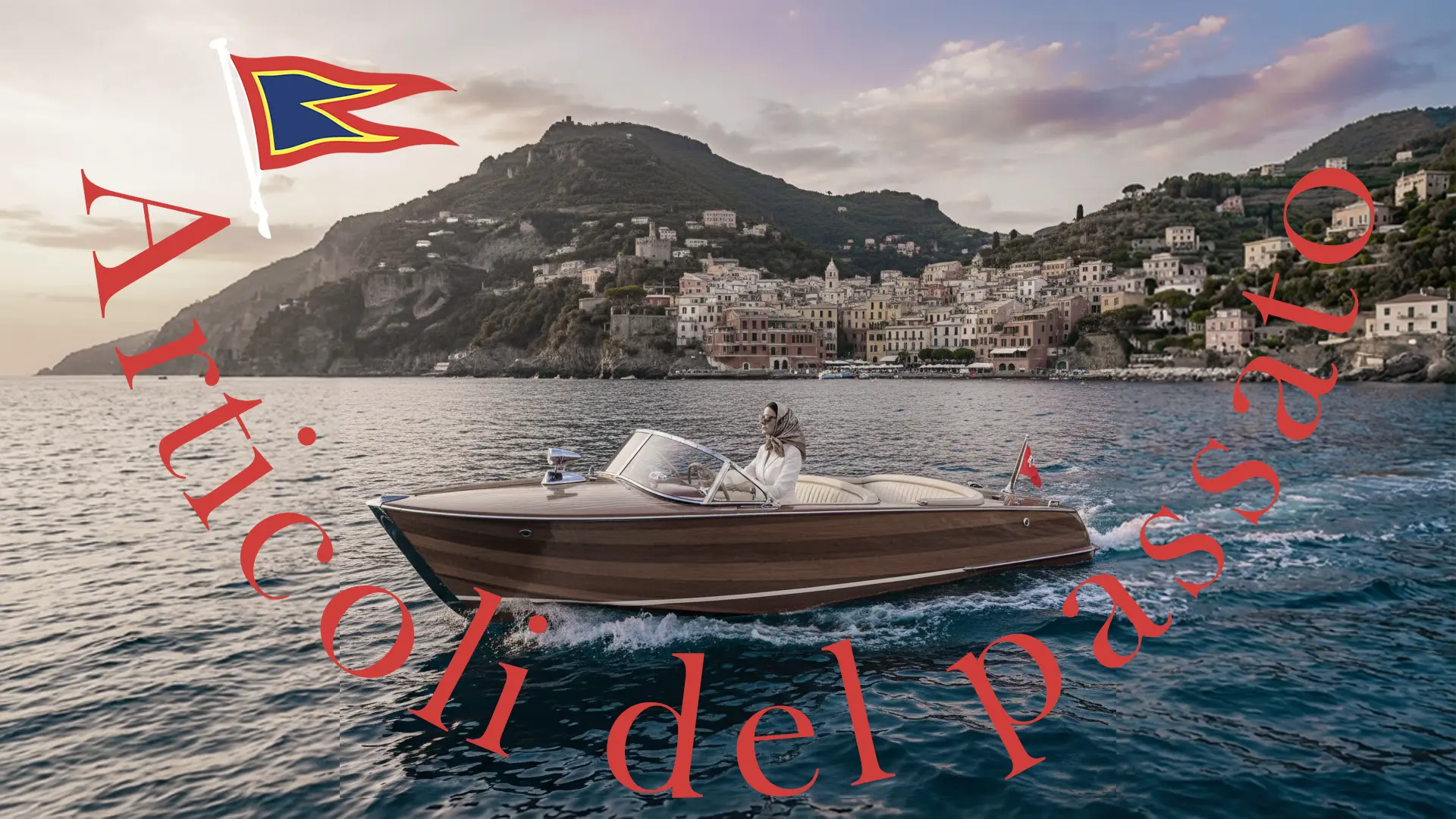
It is true, plastic boats require no maintenance.
And yet, as a friend of mine who owns a shipyard used to tell me, they cannot be abandoned either; they must be checked, and every now and then, a coat of paint certainly does them no harm. ‘I’ve never painted as many boats in a single winter as I did last year—and almost all of them were plastic,’ he told me a few years ago.
As for vintage wooden boats, we all know it: if they are left out in the elements, they decay.
This is absolutely true. But let us take a deeper look at this issue—one that is very close to the hearts of all of us who own wooden boats, especially vintage ones, whether they are powerboats, sailboats, or rowing boats.
‘Wooden boats get damaged by being used’—that is the current mindset. But it isn’t true; they get damaged by being left outdoors, whether they are used or not.
Let’s take an example: those beautiful Venetian Taxis, all in polished, gleaming mahogany, are varnished as many as two times a year. It’s not always a deep, complete job, but they get at least a fresh coat of varnish.
This means that, to keep a boat in top condition, the interval between one maintenance session and the next can be roughly estimated at about 200 days.
But for the owner of a vintage wooden boat, 200 days of actual use can easily represent ten or even twenty years of life.
This is because the pleasure of owning such a boat essentially boils down to two factors: the first is the sheer fact of ownership itself—because she is beautiful, possesses a very unique charm, and often carries a history, perhaps even a significant one, all of which justify being her owner. The second factor is the pleasure of using her. Yet, more often than not, she is used as follows:
During the first year of ownership, when everything is still fresh, you try not to miss a single opportunity to use her. I remember when I was young and already deeply passionate; I had managed to buy a used Boston Whaler Outrage, which I kept in a covered boat slip.
Enthusiastic and passionate, I never missed a chance to get behind the wheel.
By the end of the season, it felt as though I had used it immensely—and indeed, I had. Yet, the hour meter showed only 55 hours. This means that, in an entire year of significant activity, I had used it—and consequently degraded it—by an amount corresponding to no more than twenty or thirty days of outdoor exposure. > In the following years, however, the opportunities to use our boat tend to decrease. Not because there are objectively fewer chances, but because, once the initial enthusiasm fades, you discover that vintage boats, compared to modern ones, are full of flaws: powerboats usually slam against the waves, their livability is not exceptional, and they are often ‘wet’ boats, meaning that spray tends to soak the passengers.
They are certainly far less comfortable than today’s boats.
And the lack of comfort of these objects of admiration and desire is only partially compensated for by the pleasure of using them while admiring their beauty and charm. Yet, this admiration remains, regardless of whether one is actually sailing or not.
Consequently, once those first years of euphoria have passed, the frequency of use decreases and often settles into attending a few rallies and a handful of other sporadic outings. This is also due to the fact that, normally, the boat is only used on weekends and during the summer season. Then it rains, or other, more convenient commitments arise. If we calculate the total days of actual use, we see that they are limited to very few—likely no more than 10, perhaps 20 days a year.
This means—still using the Venetian Taxi as a benchmark—that maintenance work would only be needed every ten or twenty years of use, or perhaps even longer, rather than twice a year like those taxis that are constantly left outdoors. Naturally, this is on the condition that the boat is kept under cover whenever it is not in use.
But there is another problem: where to keep the boat.
Naturally, given the premise that a wooden boat deteriorates when left outdoors, regardless of use, one certainly cannot leave her moored at a pier or parked in an open lot. The ideal solution would be to keep her in a closed building, but if necessary, even just keeping her under cover, beneath a shed or a lean-to, would suffice.
There are usually two alternatives: the first—the simplest and most convenient, but also the most expensive—is to keep her at a marina or a shipyard. The second, which is more economical and even more enjoyable, is to keep her at home. How? On a boat trailer, of course.
This is the idea that makes all the difference. It is certainly not very original, yet curiously, it is practiced by very few—at least here in Italy.
And finding a place to keep a boat trailer—with our beloved vintage boat resting upon it—under cover is not that difficult.
As we were saying, an indoor space is not strictly necessary. It is enough that the hull, protected by its cover, is exposed neither to sun nor rain, and—most importantly—that no condensation forms. To achieve this, a simple shed or lean-to is more than sufficient.
And if a perfectionist owner wants to prevent even the boat cover from getting dusty, a simple plastic sheet—or better yet, any breathable fabric—tied loosely over it will solve that annoying problem as well. Once a year in the washing machine, and you’re all set.
As I was saying: those who are lucky manage to keep their boat right at home, under a shed or, better still, in a garage.
For those who aren’t quite that lucky, I believe it wouldn’t be too hard to find a friend with some shed space in a farmhouse or an old country home with room under cover. Or perhaps a local craftsman with a small business who might, without much trouble, do us the favor of letting our little boat rest on her trailer under his roof.
If you find such a spot, it can be a very economical arrangement. Alternatively, one might consider caravan and motorhome storage facilities, which are quite numerous and affordable. For instance, in Central Italy, storing a 6.5-meter long and 2-meter wide motorboat on its trailer under a shed for an entire year costs 300 euros, VAT included.
Is all of this very inconvenient? Perhaps not—let’s look at the details:
The process of using a boat on a trailer is very similar to that of a boat kept in the water. You still need to pack your swimsuits, towels, and your bag of fins, not to mention the picnic basket. Once everything is ready, it has to be carried to the car trunk, and from there to the boat in the water once you reach the harbor. But then, instead of hauling bags and gear from the trunk to the boat at the pier, isn’t it simpler—or at least equivalent—to move them directly from the house or the car into the boat while it’s still on its trailer?
Launching the boat is then very easy using a slipway, provided the trailer is properly set up.
Unfortunately, these slipways—which are very common abroad—are a rarity in Italy; however, some do exist. The alternative is to go to a marina or a shipyard equipped with a crane and have them launch it for you, for a fee, of course. Still, this costs far less than leaving the boat permanently in a marina or a harbor.
The journey between the place where the boat is used and one’s home has to be made anyway; the fact of traveling it with or without the boat in tow doesn’t significantly change the travel time, especially given the heavy traffic of summer weekends.
Driving with a trailer in tow is not particularly difficult, either. It truly only requires a little extra attention.
Obviously, all these considerations limit the choice of boats to smaller ones—even though abroad we often see long, tall, and heavy boats being towed, such as Dragons, 5.5 Metre S.I., and I believe even 6 Metre S.I. yachts. Naturally, this requires adequate vehicles.
These final considerations apply to almost all small boats, regardless of the material they are built from; now, however, let’s look at something specific to wood, whether vintage or modern.
By choosing to launch a wooden boat only when in use, and never leaving her in the water or under the sun for more than a couple of days, there is no need to let the wood soak to become watertight. With such brief exposure, the timber doesn’t have time to absorb water, swell, and subsequently shrink upon drying—a cycle that would cause leaks during the next outing. It is a well-known principle: boat timber should either be kept always dry or always wet. It is the concept of pre-stressing.”
“In traditional construction, this is applied to the planking through caulking: this process puts the planks under tension (pre-stressing) so that the entire structure becomes taut and solid. This concept was perfectly captured by the concise yet incisive words of the old master shipwrights. Upon finishing a good caulking job, they would say: ‘It rings like a bell.’ A very eloquent example can be found on Lake Como with its most traditional craft, the Gondola Lariana—a 12 to 18-meter transport boat, completely open and deckless. Once the hull was assembled, if shaken violently, it would twist and ‘move’ because the planks were joined but not yet pre-stressed by caulking. They weren’t a single block. Only after caulking did the tensioned planking become monolithic.”
“It is fascinating to think how a long succession of small hammer blows on the oakum, skillfully delivered by the caulker, can achieve such a significant structural transformation in a traditionally built hull. But caulking achieves a second, equally vital result: waterproofing. As they get wet, both the oakum and the wood swell, creating perfect adhesion and becoming—much like a wine barrel—perfectly watertight. A similar process occurs with clinker-built boats, such as a 12-foot Dinghy. The only difference is that, without oakum, the seal is achieved directly between the planks: the wood swells and ensures the hull is watertight.
The downside of these traditional systems lies in their maintenance: caulking must be redone or at least touched up every few years, and clinker planking needs to be soaked and sealed at the beginning of every season. Moreover, the periodic cycle of wetting, swelling, and shrinking causes the entire structure to loosen over time. This eventually leads to the necessity of extraordinary maintenance: re-peening all the copper nails.
Other construction methods, such as double-planking or carvel-planking, share these same characteristics, albeit to a lesser extent.
So, how can we avoid all these problems and the resulting maintenance costs?
Personally, I am in favor of a treatment that achieves this mechanical pre-stressing by coating the wetted surface (the ‘opera viva’) or the entire hull with epoxy resin. This means tensioning the whole structure by applying an external layer of glue/structure which, while adding a bit of weight, makes the planking rigid and, above all, watertight. The crucial factor, however, is to never allow the wood to become damp again. When treated with waterproof epoxy resin on the outside and painted on the inside, the wood will only get wet if water is left in the bilge for a prolonged period. Daily use, or even a weekend outing, is not enough for moisture to penetrate the planking, which will thus remain dry and intact indefinitely.
In conclusion, as is often the case in life, it is a matter of choice: it is about trading the inconvenience—or rather, the impracticality—of keeping our boat in the water for long periods for the advantage of reducing maintenance needs almost to zero. There is an additional small benefit for those who have the will and the time: the ability to personally and comfortably follow or carry out those small maintenance tasks that boats, especially older ones, require, right at home. From simple washing and cleaning to changing the oil and spark plugs, to winterization and similar chores. These tasks are simple but can be numerous; doing them yourself adds another layer of savings to the overall balance.
Such operations can be comfortably carried out during the shoulder seasons—for instance, on those rainy autumn days.
Working inside your own boat, sheltered under a porch with the rain drumming outside, is yet another way to enjoy a pleasant companionship with your beloved craft, even during the off-season.