
Must the old original sails be used?
Author: Zanoletti / Pavese / Lodigiani
07/02/2024
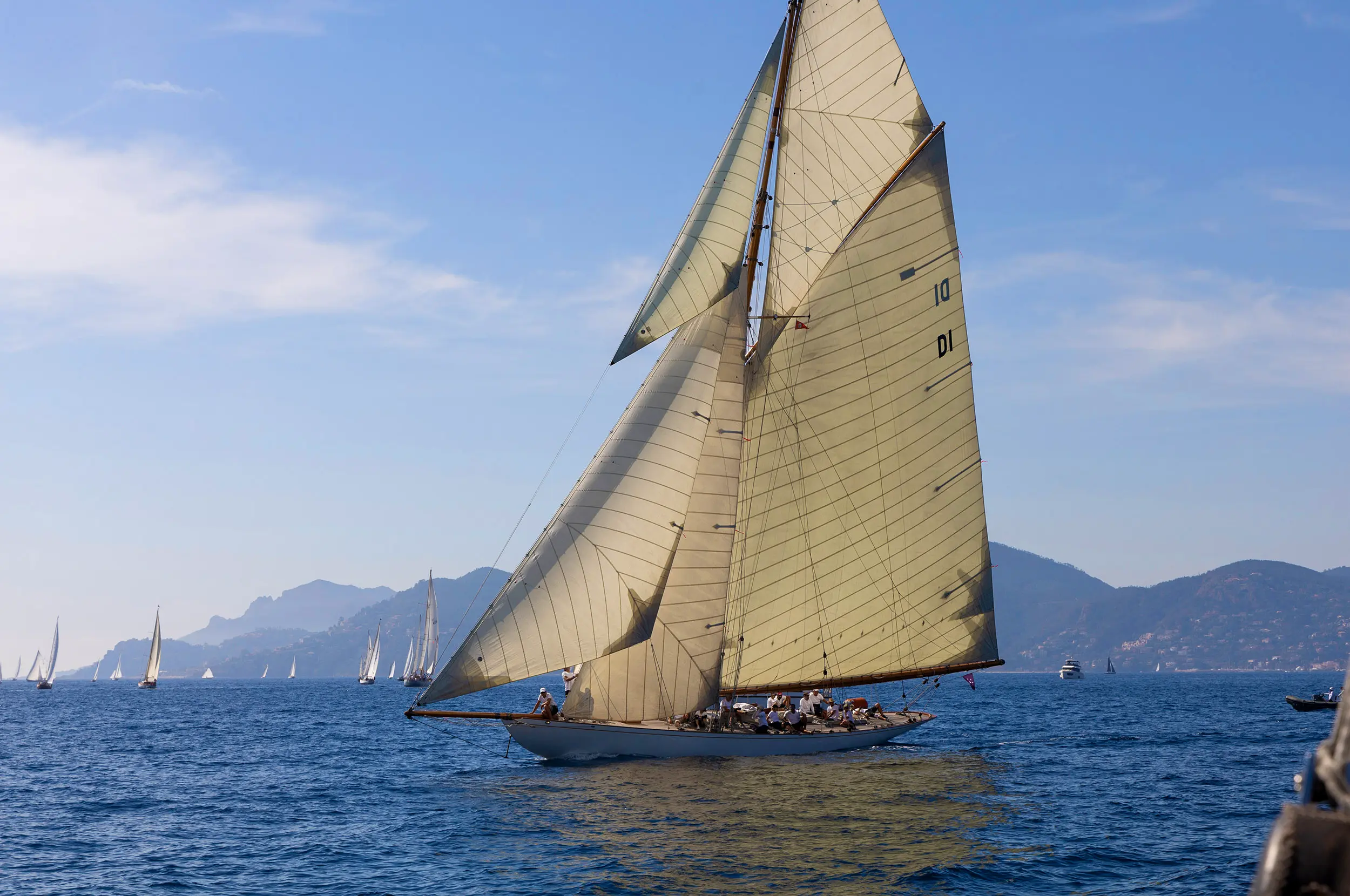
by Gianalberto Zanoletti
Often in conversations among historic sailing enthusiasts, the phrase ‘original cotton sails’ comes up. The question regularly arises: does a boat with original sails, as well as the mast, hull, interiors, and eventual engine, all original, have greater value than a boat with these elements new or refitted? From a historical point of view, the answer is absolutely positive.
The knowledge of how the sails were built, the cut they had, the construction details, certainly increases the understanding of that particular type of vessel or equipment. The question arises when a boat of this kind must sail or participate in an event, such as a regatta. Aside from performance and efficiency, does a set of sails several decades old, which is certainly much less efficient, lend greater prestige or historical value to a boat as a whole? My personal opinion is no.
Here I report some passages from a ‘diatribe’—much more akin to an amiable conversation than a heated discussion—with my very dear friend Paolo Lodigiani, whose gentlemanliness and competence in the field of traditional and historic boats I deeply appreciate.
Paolo writes in this article from a few years ago entitled: ‘In Conversation with Two Old Boats’
Should vintage boats be sailed? I confess that until October of last year, I had never asked myself this question, as the affirmative answer seemed obvious to me. The incident that undermined my certainty about this occurred during the vintage sail gathering held on Lake Como, which I attended with a small dinghy of the ‘Serie Laghi’, a class created in 1923 in Cernobbio with the ambition of becoming the Italian competitor of the well-known and widespread 12′ Dinghy. Since I have had two of these perfectly seaworthy boats, complete with all their original equipment, in my family since the class’s inception, it seemed like a good idea to entrust one of them to our President Gianalberto Zanoletti for the gathering.
Knowing his passion, competence, and seamanship, I believed the boat could not have had a more worthy helmsman. I had immediate confirmation of how right the choice was by the fact that in a fine tack from Moltrasio to Cernobbio against a pleasant breva [a local breeze], Gianalberto managed to prevail in the friendly but competitive match race we had engaged in. It had been a beautiful sail, in the gentlemanly and relaxed style of yachting from yesteryear, further cheered by a warm late-autumn sun and the pleasant company of other crews who shared our passion. Landing in Cernobbio, I expected to find my friend Gianalberto beaming with joy from the combination of all these ingredients. I was therefore surprised to see him slightly nervous, almost overshadowed, as if tormented by a private and unspoken worry. Pressed by my questions, he eventually revealed to me that, while he appreciated my invitation, he deplored the fact that I calmly used such valuable boats, exposing them to the risk of damage that could even be irreparable. I was shaken by this reproach, which was expressed in a very polite manner: I would be exaggerating to say it cost me sleep, but since then I have been wondering if I am right to use my vintage boats, and I never miss an opportunity to gather the opinions of other enthusiasts on the matter. I have received the most disparate views. There are even those who maintain that all boats, whether vintage or modern, should never be put in the water: it is from the moment a boat gets wet that the joys cease and the sorrows begin for the owner. Perhaps a somewhat apocalyptic idea, but not without foundation.
To which I replied:……………………..I realized that everything I was using at that moment was undergoing degradation, precisely because I was using it. The original twisted hemp ropes, the cotton sails of the time were getting wet, the leather reinforcements were wearing out; in short, every time I tacked, I saw the moment approaching, even if only slightly, when these perishable components would no longer be able to fulfill their duty because they were consumed or rotten; in short, it’s as if your boats have a punch card. Each day of use is worth one punch, and the days of use, like the punches on the card, are limited. Once all the punches are used up, your card is finished.
If you ask me, mine is perhaps an excessive scruple, but I don’t think so, because the day the components mentioned above are no longer usable because they are degraded, the materials to replace them will no longer be found, and perhaps—but I repeat, perhaps, and in any case with great effort—you might manage to restore or remake them.
The reason for my doubts is that, while historic boats can be restored, and with excellent craftsmanship the result can be philologically very correct, regarding the sails the matter is more difficult, also because the material—true Egyptian cotton (makò cotton), or sometimes even the silk with which they were occasionally built, though very rarely—has now become unobtainable, like many other materials.
In fact, for some decades now, sails on historic boats have been built from a synthetic material that is very doughy to the touch, very soft, and very similar to cotton, although, in my opinion, unfortunately a little too yellowish. Certainly, good sailmakers are perfectly capable of reconstructing a sail using the same techniques of the era in which the original was built. If it weren’t for the color, at sight, and often even to the touch, it is even difficult to distinguish the original from the reproduction made today. Returning to the question in the title, ‘Should the old original sails be used?’ another idea comes to mind. At the Museo della Barca Lariana in Pianello del Lario, where about 400 mostly pleasure boats, many of which are sail boats, are preserved, we have chosen the option, except in exceptional cases, to refrain from restoring the boats. It was a highly debated decision and not approved by everyone. Giving up an appealing look in favor of preserving intact the historical documentation is more the reasoning of an archaeologist than a vintage boat enthusiast. One of the reasons that led us to this decision is the fact that, putting ourselves in the shoes of a scholar or enthusiast who, fifty, one hundred, or two hundred years from now, wanted to study a vessel conserved at the museum—a vessel that has not recently undergone any maintenance work—they will have the opportunity to understand, analyze, and perfectly realize what the original techniques, materials used, and construction systems were.
The choice to conserve boats as they are without restoring them is neither an obvious nor a generalized one. The oldest known Venetian gondola is preserved at the Mariner’s Museum in Newport News, Virginia. It has an unusual history. It was built in the first half of the nineteenth century. Towards the end of the nineteenth century, it was still in Venice when a wealthy American fell in love with it and brought it home to America. It was always conserved, albeit not always ideally, until it was finally donated to the museum by the heirs. It was not in excellent condition, so the Americans decided to have it restored. They followed absolutely logical reasoning: where better to choose to have a Venetian gondola restored than in Venice? So, they inquired, chose the best traditional Venetian shipyard, Tramontin? And they also involved my friend Giovanni Penzo, writer of texts on the construction technique of ancient Venetian boats and one of the world’s leading experts in the field, in the restoration.
The moral of the story is, the boat arrived at the Tramontin shipyard and the first statement from Mr. Tramontin upon seeing it was: ‘What an ugly gondola.’ Indeed, the shape of the current Venetian gondolas, so ‘banana-shaped’ (bananate), is fascinating but not very profitable for rowing; the ancient one, on the other hand, built before the advent of the engine and the resulting wake, has a less pronounced sheer line (cavallino), but is much more efficient under the effort of the oars. The moral of the story is, Giovanni Penzo was at the shipyard every day ‘picking a fight’ (fare baruffa) because his idea was to preserve the existing material as much as possible. The shipyard’s idea, however, was—justifiably from their point of view—to assume the responsibility of making the boat seaworthy again. The fact is, it was a pity because, in doing so, a lot of stuff was thrown away. Penzo writes: ‘…throwing away and remaking a lot of rotten stuff, which is practically almost everything.’ Penzo also writes: ‘Having to guide the restoration (of this American gondola), I had to, as always, employ high diplomacy to reconcile the needs of the client—who generally desires a dazzling result—and those of the artisans—who seek to shorten working times and cannot change their methodologies—with the orthodoxy of a historical restoration intervention. My advice was therefore to carry out an intervention that was as light as possible, removing the overgrowth (superfetations) and, in compliance with the most modern restoration techniques, reinforcing the hull with products that are as reversible as possible.
It was naturally impossible to make the shipwrights (squerarioli) understand the difference between restoration and repair, or to prevent them from ‘improving’ some details, convinced as they are that, for example, epoxy resins (and this is true in an absolute sense) are better than ancient glues. Regarding the finish of the hull, it was decided to paint it again, having already been repainted multiple times in recent times. We had an oil paint prepared with a formula as similar as possible to the nineteenth-century one, that is, with oil and carbon black (lampblack), but even in this case, I would have preferred a more orthodox intervention by restoring the original pitch up to the mark etched on the hull below the masse [gondola counterweights], from which the oil enamel then began.
But then, apart from these restoration experiences and ‘philosophy’ of restoration, what should we do with the old sails? Answer: first and foremost, do not throw them away; conserve them in the best possible way, but for sailing, have new sails reconstructed—preferably with the technique, cut, and aesthetics as similar as possible to those of the original sails of the past.
The idea expressed in the ‘ASDEC certification’ regulation is also aligned with this directive, and regarding old original sails, it follows this philosophy, which I quote verbatim:
14/8 – Regarding the sails, however, a clarification must be made: for this item, only the craftsmanship, cut, and aesthetics of the new sails are judged. Using the old original sails does not lead to any improvement in the score because we believe that old sails should be considered a historical artifact and not used. Also, because being old, they are very delicate and should only be conserved instead of being used: using them greatly accelerates their deterioration (being perishable and unfortunately no longer replaceable material). The same applies to the rigging (cordage). Unlike hulls, which can be kept alive without excessive difficulty, original antique sails and ropes, once destroyed, can no longer be restored or reconstructed.
14/9 – The important thing for the assessment is that the new sails and the running rigging (cordage, etc.) have the appearance and cut of the original sails; in addition to their accessories and finishes also being philologically correct. The eventual presentation of the original sails during the certification examination, ashore or in port, will be further proof that will positively influence the assessment.
My opinion is that in the new sails to be used, the cut of the old sails should also be reproduced as much as possible. They are certainly much less efficient, also because when we talk about sails from over half a century ago, they were sails with a cut almost entirely devoid of ‘draft’ (or ‘fullness’).
At this point, the owner may be at a crossroads: either dedicate themselves solely to the boat’s performance in order to win some cups, or own and use a historic boat also for the pleasure and satisfaction of undertaking an operation of cultural preservation.
A vintage sailboat with sails designed and cut to optimize performance instead of reproducing the original ones is somewhat like performing other modifications, always with the same goal of increasing performance. Why not, then, install terrazze (wings/decks) with a certain number of people on the trapeze to increase the righting moment and consequently the speed? Or why not install, for example, beneath a ‘long keel,’ a narrow vertical fin with a counterweight bulb at its lower extremity? All of this is obviously a provocation, but, even if at different levels, the principle of new-cut sails on old boats is the same. To renounce performance in favor of historical integrity, or vice versa.
by Luigi Pavese
Dear Gianalberto,
I read your point of view regarding the use of original sails on vintage boats with great interest. I believe that the referenced ASDEC certification articles (14/8 and 14/9) contain the correct approach to the matter, especially in their reference to the original cut of the period.
This principle is also adopted by the CIM – AIVE regulation, where boats can only use sails made of Dacron or Nylon material (not original if used on boats from the early 1900s), but the cut of the panels must be strictly horizontal, even for the aft sails.
Moreover, we can identify a clear harmony also in the world of vintage cars, where the ASI, to award the maximum score, does not require mere originality, but the restoration of deteriorated materials (such as the leather of the interior upholstery) with others of current production, provided they are perfectly traceable by type and kind to the original ones.
Finally, allow me one last thought. The ‘conservative logic’ you applied to the Museum’s vessels is appreciable and completely understandable. But our ‘great passion’ (passionaccia), along with the pleasure of ownership, also includes the pleasure of use. It is wonderful to admire one’s vintage boat, but, at least for me, it is just as magical to experience the sensations of sailing her. And to enjoy this, everything must happen with the safety and efficiency that only a major restoration or continuous and precise maintenance carried out for years without interruption can guarantee.
by Paolo Lodigiani
Dear Gianalberto,
Thank you for sharing your article with me, in which you express your idea on the use of original sails and ASDEC’s position regarding their reproduction perfectly and with great clarity. My position on the matter is that your point of view is impeccable; I would even say it couldn’t be otherwise, as it’s a kind of necessary action to encourage owners to respect the antique object they have the privilege of owning and which is entrusted to their care. Therefore, I agree 100%, but with an addition, which doesn’t affect my agreement but may explain why I am not sure I will always adhere to these principles. The reason is that, in boats and in sailing, not everything depends on reason; much also has to do with the heart and emotions. I can explain this better with two examples drawn from my recent experience over two weekends spent in Trieste: the first for the Coppa Sciarrelli and Coppa Città di Trieste for vintage boats, and the second for Barcolana Classic and Barcolana. My boat, the Bat (whose 120th birthday we very pleasantly celebrated with a toast at the Adriaco Yacht Club), raced in all the events except the Barcolana, helmed by the President of the Adriaco, while I participated with my passera [a type of dinghy] designed by Sciarrelli in 2000, which I enjoy more than the Bat. The Bat always beat me. It was due to the skill of the helmsmen, but also a secret weapon they unveiled: a large, very beautiful, and efficient modern-cut genoa. Putting aside the pique of being beaten by them, I must say it was a great joy to see the BAT go like a train between two whiskers of water, powered by its new sail. This is how boats must (or want to) sail: at the maximum of their potential, efficiently, regardless of their age. A slower, more philological Bat would not have been as gratifying to watch or to sail. Another observation about the Bat: in 2002, when I restored it, I yielded to Sciarrelli’s insistence and carried out a philological restoration, removing the small coach house (tughino) that Sciarrelli himself had added to make it a cruising cutter. Now it is an open boat, just as Clayton designed it 120 years ago. All correct, but I regret it because I liked it better before.
As for my passera [a type of dinghy], I sail the Barcolana in the passera category, and until a few years ago I placed among the first. This year I finished 8th out of 14, and in the Coppa Sciarrelli, I was second to last. Here too, it’s the helmsman’s fault, but not only: almost all the other passere now rig large masthead genoas which, with the light breezes (ariette) of Trieste, become lethal weapons for the opponents. It’s all well and good that I can console myself by saying mine has the correct rig designed by Sciarrelli, that it is reasonably sailed and not oversaturated with sail. I could even get a rating allowance for all this, but when you race, you want to put the others behind you on the race course, not in the tallying of points at the committee table. Conclusion: I am considering doing as the others do next year, drawing my own secret weapon, for example, a superbowsprint with a monstrous gennaker, to return to fighting among the leaders. Having said all this, I invite you to disregard it and to confirm your position, which, I repeat, I share, but which—and I beg your forgiveness in advance—I am about to transgress.